
WORKSHOP ON DESIGNING PLEASURABLE EXPERIENCES FOR SMARTWATCHES
2021
This study formed part of my PhD research and was published and presented at DRS2022 in Bilbao. I ran a workshop with 25 design-engineering students with three aims: to test whether existing experience design frameworks translate to IoT products in design practice; to identify the essential elements of experience design for IoT products; and to explore new design opportunities arising from this context. Participants applied two established frameworks to design new experiences for a representative IoT product (i.e., the smartwatch) and presented their experience scenarios through role-play. The workshop exposed gaps in the current frameworks and showed how interactions within an IoT network can mediate user experience. The study also asks whether pleasurable elements should take priority in IoT experience design and considers how the agency of IoT products might become a tool that designers can use to shape experiences.

STUDY
Several theoretical frameworks have been developed to support the design of pleasurable product experiences. Jordan (2003) introduced a three-level model of consumer needs as a guide to pleasurable product design. Norman (2005) proposed a framework for positive emotional design with three corresponding design levels (visceral, behavioural, and reflective) grounded in how the human brain processes information. Desmet and Hekkert (2007) developed a general framework for product experience covering all affective responses across three levels: aesthetic experience, the experience of meaning, and emotional experience. Hassenzahl (2010) put forward a goal-directed hierarchy of motor-goals, do-goals, and be-goals (from lowest to highest). These frameworks, however, predate the proliferation of IoT products and were built around desirable experiences for individual users. Whether they still hold up in an IoT context needs to be tested. I compared the four frameworks against the three types of interaction found in an IoT network: between things and humans, between things, and between humans. None of them accounts for interactions between things, exposing a potential blind spot when applying them to IoT design. Without that consideration, designers risk overlooking a defining feature of IoT products: the agency of things during the design process. To investigate this, I ran a workshop examining what issues surface when two of these frameworks are applied to IoT products, and how designers might refine them. I chose Jordan's framework for its emphasis on consumer needs and Hassenzahl's for its focus on user motives, with the smartwatch, a well-established commercial product, as the design subject.

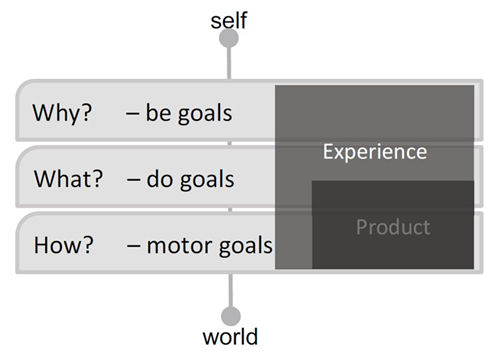
The two experience framework I introduced in the workshop - Hierarchy of consumer needs adapted from Jordan’s framework (2003) and Hassenzahl’s hierarchy of goals and top-ten phycological needs in user experience (2010)
PROCESS
The workshop consisted of two activities. In activity 1, students were asked to design a new smartwatch experience using one of the two frameworks as a guide. Smartwatches were chosen because they have evolved in recent years from non-IoT into networked products (Swan, 2012), and my earlier work had identified meaningful differences between the user experience of a smartwatch and that of a traditional wristwatch. The aim was to put the frameworks under pressure in an IoT context. Participants were divided into five groups, each given a pre-set Miro whiteboard. Groups analysed the smartwatch and their chosen framework, captured brainstormed ideas through sticky notes and doodles and presented their final concept through sketches and images on the board. In activity 2, students presented their designed experience through role-play. Staying in the same groups, they had 15 minutes to discuss and build a narrative, then performed a use scenario in front of their cameras on Zoom. Designers took on the roles of both user and IoT product, acting out the experience as it would unfold in real use.
RESULTS & FINDINGS
Participants produced a wide range of ideas, shown in the images below. I compared the concepts against the three types of interaction in an IoT system. Only groups 1 and 5 addressed thing-to-thing interactions and human-to-human interactions mediated by things; the other three focused solely on human-to-thing interactions. That said, all five concepts illustrated how the agency of IoT products shapes experience. Pleasure, however, was not a universal priority: only group 1 placed pleasurable experience at the centre of their concept, while groups 2, 3 and 4 pursued other goals.

Utilising Jordan’s framework as a guideline, Group 1 designed a smartwatch experience that facilitates local social interactions. Users can share their GPS location and track the location of their friends. The smartwatch calculates the distance between users and alerts them when a friend is nearby. If the user wishes to meet, the smartwatch provides navigation assistance.

Employing Hassenzahl’s framework, Group 2 designed an experience for smartwatches aimed at helping users manage their dietary nutrition. The new feature uses the gyroscope to monitor the user’s arm movements during eating and a voice sensor to identify food types based on the sounds produced by the user’s throat and mouth. Utilising machine learning, the application estimates the user’s nutritional intake from the collected data and provides dietary suggestions through a virtual assistant.

Utilising Hassenzahl’s framework, Group 3 designed an experience that enables users to record memorable locations visited during hikes or walks, facilitating the convenience of revisiting these places. They integrated a cortisol sensor into the Apple Watch to analyse how moments are converted into memories. The sensor assesses cortisol levels in the body, allowing the smartwatch to infer the user’s mood.

Utilising Hassenzahl’s framework, Group 4 redesigned the exercise experience with the Apple Watch. Noting that the existing exercise function had become less effective and was difficult to pause or cancel, two long-term users in the group improved this feature. They integrated the calendar to identify break times, during which the smartwatch prompts users to exercise and suggests appropriate routines.

Applying Jordan’s framework, Group 5 designed a smartwatch experience in extreme scenarios such as climbing and expeditions. They determined that Bluetooth, radio, Wi-Fi, GPS, or a combination of them could be used to locate users, particularly in low-visibility conditions. The smartwatch features a mini-map to prevent users from getting lost. Additionally, they developed a function for life-threatening situations in extreme environments, allowing users to leave a message for their family accompanied by a photo, which could offer comfort during difficult times.
INSIGHTS
The study contributes the following insights:
Existing UX frameworks fall short for IoT products
They do not account for four elements that designers need to consider when designing IoT experiences: whether pleasurable experience should take priority; how immaterial resources such as algorithms, software, and data shape experience; the specific scenarios in which IoT products are used; and the characteristics of, and relationships between, each thing in the network.
The agency of IoT products can mediate experience.
As shown in the diagram below, the agency of IoT products plays an active role in shaping how users experience them. Looking ahead, designers may need to co-design experiences with things, developing new practice-based methods for shaping IoT experience by mediating that agency.

The relationship between agency, interactions and experience in an IoT system
More details of this study can be found in the publication.
PAPER PRESENTATION
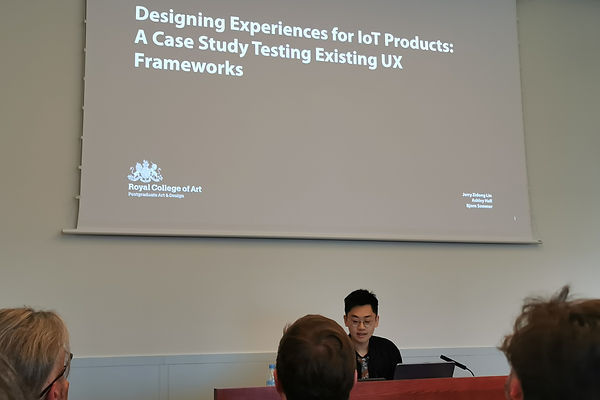
DRS2022 was particularly meaningful to me. It was the first conference I attended in person during my PhD, and it marked the end of the COVID-19 pandemic, the first time design researchers could finally discuss their work face-to-face again.
REFERENCE LIST
Desmet, P. M. A., & Hekkert, P. (2007). Framework of product experience. International Journal of Design, 1(1)2007, 1(1).
Hassenzahl, M. (2010). Experience Design: Technology for All the Right Reasons. Synthesis Lectures on Human-Centered Informatics, 3(1), 1–95. https://doi.org/10.2200/S00261ED1V01Y201003HCI008
Jordan, P. W. (2003). Designing pleasurable products: An introduction to the new human factors. Taylor & Francis e-Library.
Norman, D. A. (2005). Emotional design: Why we love (or hate) everyday things (Paperback edition). Basic Books.
Swan, M. (2012). Sensor Mania! The Internet of Things, Wearable Computing, Objective Metrics, and the Quantified Self 2.0. Journal of Sensor and Actuator Networks, 1(3), 217–253. https://doi.org/10.3390/jsan1030217